 Hebrew
  English
  Spanish
  Arabic
  Portuguese
  Russian
  French
  German
  Korean
  Japanese
  Italian
  Turkish
  Vietnamese
  Thai
Thai  Indonesian
  Dutch
Dutch Polyester sewing thread selection made practical: filament vs spun, 50/2–60/3 sizing logic, and troubleshooting for breakage, lint, skipped stitches, and shade consistency. Built for buyers and factories to improve runnability and seam stability.
How to Match Thread Type to Real Sewing Conditions
“Can you send us your best polyester sewing thread?”
That was the buyer’s email. Simple, right?
I replied with one question: “Best… for which fabric, which needle, and which machine speed?”
Silence. Then: “We’re getting thread breaks on denim seams, lint in the hook area, and shade differences between lots. We just need it to run.”
If that sounds familiar, this guide is built for you. On polyester sewing thread, “good” isn’t a marketing adjective—it’s a measurable system: strength stability, elongation control, twist balance, finish consistency, and the boring-but-deadly details like lubrication and spool build.
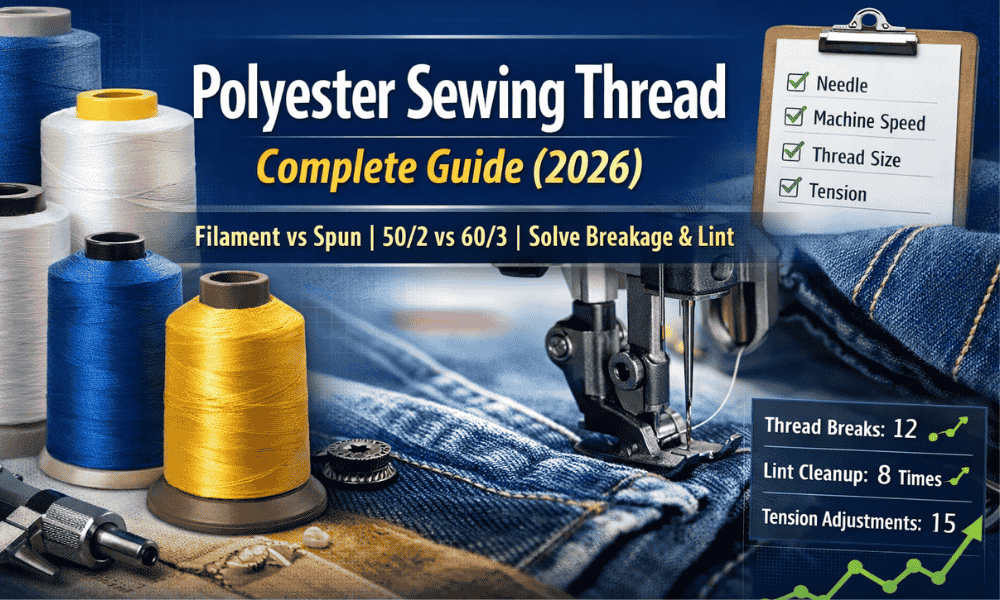
Polyester Sewing Thread
Why Polyester Sewing Thread Wins in Modern Production
Polyester thread became the default in many apparel lines for one brutal reason: it tends to stay predictable when production is not. Humidity changes, long sewing hours, high-speed machines, repeated washing, abrasion at seam edges—polyester usually handles this “daily punishment” better than many natural alternatives because of its balanced strength and durability profile.
But here’s the trap: buyers treat polyester like one category. In reality, there are multiple “polyester threads,” and the wrong one behaves like a saboteur—snapping at needle heat, fuzzing into lint, or causing seam puckering when twist and finish aren’t matched to the fabric.
If you want the short procurement truth: choose thread like you choose a component, not a commodity. Your supplier’s process control, testing discipline, and batch-to-batch consistency matter as much as the label “polyester.”
If you need a quick look at how the brand frames capability and production mindset, start at About Us—it helps you understand how thread performance is approached as a supply-chain problem, not just a product description.
Type Selection: Spun vs Filament vs Bonded (The Detail That Decides Everything)
1) Spun polyester thread (common in apparel)
Spun thread often behaves like a “grippy” workhorse—good seam appearance, friendly handling, and broad usability. If your line is mixed fabrics (woven + knit) and you need stable sewability, spun polyester is a standard starting point.
Best fit: general apparel, balanced seam appearance, medium-speed lines.
2) Polyester filament thread (smooth, strong, clean-running)
Filament threads are typically smoother and can reduce fuzz/lint compared with spun in many setups. That smoothness can also mean different tension behavior—great when tuned, annoying when ignored.
Best fit: higher speed sewing, reduced lint targets, certain technical textiles.
3) Bonded polyester thread (abrasion-resistant, heavier-duty feel)
Bonded finishes are often used where abrasion resistance and seam durability matter, especially in demanding applications. It’s not “better,” it’s purpose-built.
Best fit: heavy-duty seams, abrasive environments, reinforced products.
If your buyer goal is to compare suppliers rather than only products, read best polyester sewing thread manufacturer and use it like a supplier audit lens: capability, QC discipline, and consistency signals matter more than buzzwords.
Size Systems Made Simple: What Buyers Should Actually Ask For
Thread size is where misunderstandings quietly destroy production. Buyers say “We need strong thread,” but production needs: size, ply, twist, finish, and compatibility.
Use this practical checklist when specifying:
-
Application & fabric: denim, knit, uniform, workwear, light woven
-
Stitch type: lockstitch, chainstitch, overlock
-
Needle range: size and point type
-
Machine speed range: actual RPM, not “fast/slow”
-
Seam requirement: appearance vs durability vs abrasion resistance
-
Performance priorities: breakage reduction, lint control, shade control
And here’s the “deadly detail”: thread performance often fails not from “low strength,” but from heat + friction + tension instability. If a thread is strong on paper but poorly finished or inconsistent lot-to-lot, it can still break more often on the line.
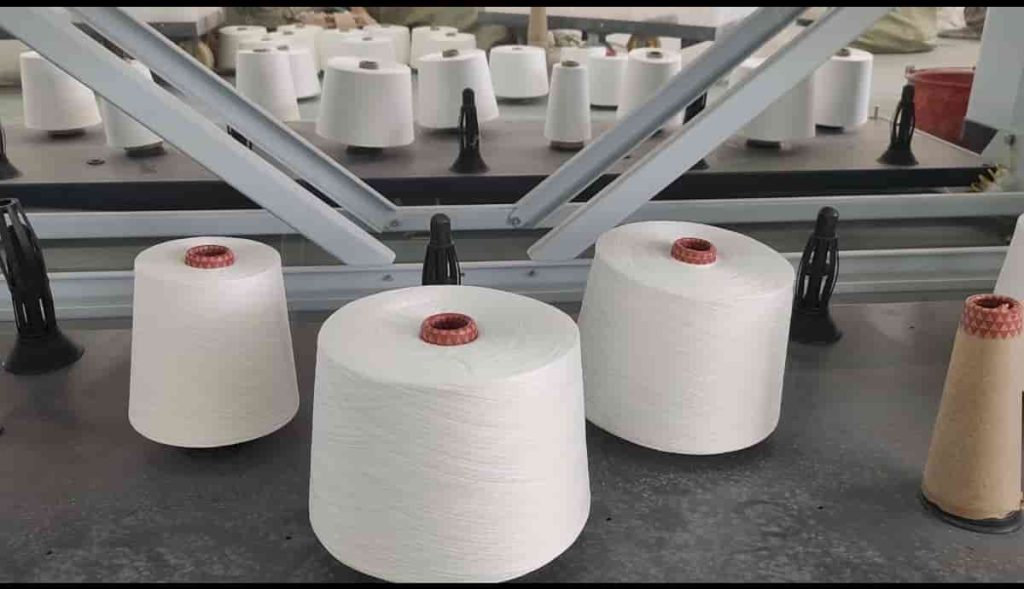
Polyester sewing thread
Product Matching: When Filament No.5 Is the Right Call
If your pain point is lint buildup, frequent cleaning, or inconsistent runnability at higher speeds, filament options can be worth testing.
A practical scenario where filament No.5 often enters the conversation:
-
You’re running continuous production
-
You want smoother thread path behavior
-
You’re trying to reduce fuzz accumulation near hooks
-
You need clean seam lines on certain fabrics
For the exact product reference and how it’s positioned, see polyester filament sewing thread No.5—then map it back to your machine speed, needle selection, and target seam outcome.
Case Logic: 60/2 and 60/3—Where Small Changes Create Big Production Differences
Think of 60/2 vs 60/3 as a “control knob” for balancing seam appearance, strength feel, and running stability. The wrong choice won’t always fail dramatically—it will fail expensively, through micro-stoppages, rework, and operator adjustments.
Typical selection logic
-
60/2: often used where you want balanced sewability and a cleaner, lighter seam profile
-
60/3: often chosen when seam durability, stress handling, or a stronger seam “feel” is needed
What to test (instead of arguing opinions)
Run a simple A/B sewing trial and record:
-
breaks per 1,000 meters sewn
-
lint cleanup frequency per shift
-
tension adjustment count per operator per hour
-
seam appearance score (your internal grading)
-
stitch consistency at your top speed
Then lock the winner into your spec, not your memory.
For the product reference points and to align your inquiry language, use polyester sewing thread 60/2 and 60/3 as the internal anchor—your team can standardize the naming and reduce “we meant something else” confusion.
50/2 and 50/3: The Workwear Mindset (Durability Without Drama)
If 60-series is often about “balanced apparel flow,” 50-series is where many factories focus on a sturdier performance profile for heavier fabrics or tougher seam demands.
Where 50-series is commonly evaluated
-
Denim and heavier woven garments
-
Uniform and workwear seams
-
Stress points: pocket corners, waistband joins, reinforced edges
-
Situations where seam durability matters more than ultra-light seam appearance
The buyer trap
Factories sometimes jump to “thicker/stronger” without checking:
-
needle compatibility (wrong needle can shred thread)
-
stitch formation stability (especially at speed)
-
finish and lubrication appropriateness for your machine environment
Again: test it like an engineer. If your sewing line is sensitive, “stronger” can backfire by increasing friction heat or tension instability—leading to more breaks, not fewer.
For the exact product options and internal spec alignment, refer to polyester sewing thread 50/2 and 50/3 and attach your fabric + stitch + speed info when you evaluate.
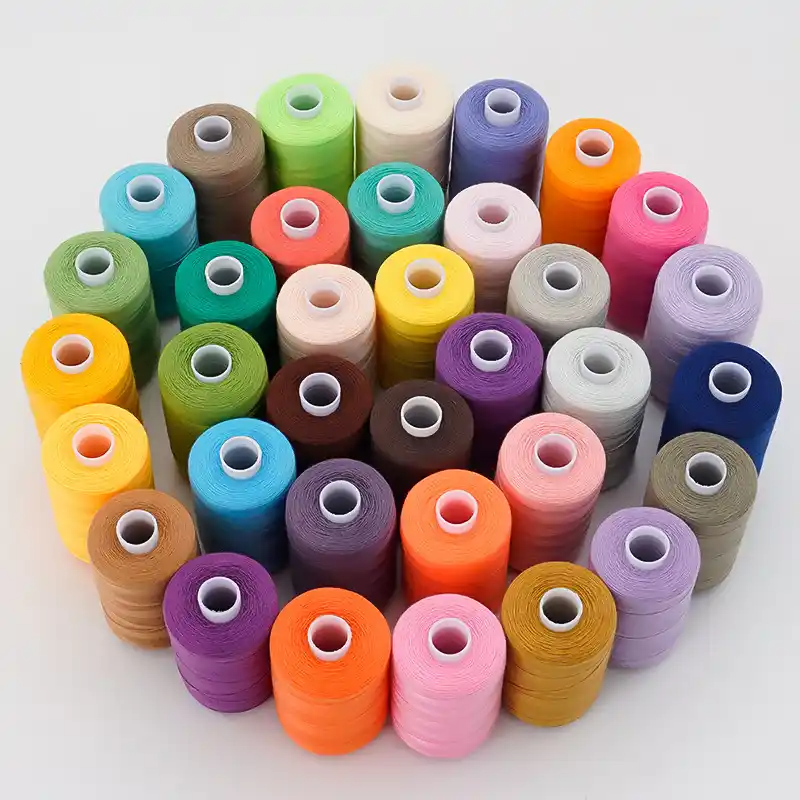
Polyester Sewing Threads
Troubleshooting Map: Pain Point → Root Cause → Fix
Below is a line-friendly diagnostic map. Use it as a “first 30 minutes” checklist before you blame the thread.
Thread breakage
Likely causes: needle heat/friction, poor tension stability, wrong needle size, finish mismatch, burrs on thread path
Fixes:
-
verify needle size/point vs fabric
-
inspect thread path for burrs
-
reduce top tension slightly and retune bobbin
-
trial a filament or different finish if lint/heat is high
-
standardize operator threading procedure
Lint and fuzz buildup
Likely causes: high abrasion path, spun thread fuzzing, poor finish consistency, needle/fabric abrasion
Fixes:
-
trial smoother filament option
-
confirm correct needle and stitch setup
-
implement scheduled cleaning intervals and track improvements
Skipped stitches
Likely causes: needle choice, tension imbalance, thread size mismatch, knit elasticity behavior
Fixes:
-
adjust needle type (especially for knits)
-
confirm thread size matches stitch formation needs
-
stabilize tension and reduce rapid speed jumps
Shade mismatch between lots
Likely causes: dye lot variance, inconsistent batching, weak shade control
Fixes:
-
demand lot control and shade approval samples
-
pre-approve shade under your production lighting conditions
-
document accepted tolerance internally
Industry Pulse: Why “Compliance + Circularity” Is Quietly Reshaping Thread Specs
Here’s the trend that’s sneaking into thread procurement: brands and regions are tightening sustainability and compliance expectations, and thread is no longer “too small to matter.”
-
In Europe, industry bodies have been vocal about fixing systemic textile waste and regulation direction, which increases pressure on traceability and material choices across the supply chain.
-
Major thread players are also investing in circularity innovations and preferred raw materials goals, making thread a more visible component in sustainability reporting.
What does that mean for you (practically)? Even if you buy standard polyester today, procurement conversations increasingly include:
-
batch traceability and documentation readiness
-
consistent quality systems to reduce waste/rework
-
material transition roadmaps (where applicable)
So yes—thread is becoming “strategic.” Annoying, but useful if you want stable supply.
Buying Checklist: What to Request Before Bulk Ordering
Use this procurement checklist to reduce risk:
-
Sample policy: request controlled samples by size and type
-
Lot consistency: confirm how dye lots and production lots are managed
-
Testing approach: ask what is measured per batch (strength, elongation, evenness, etc.)
-
Machine compatibility: provide your speed range, stitch type, needle range
-
Packaging stability: spool build consistency to avoid tension instability
-
Change control: ask how they handle process/material changes
And one more “fatal detail”: if your factory has multiple lines, don’t test on one machine and assume universal success. Run trials on representative machines—especially the ones that always complain.
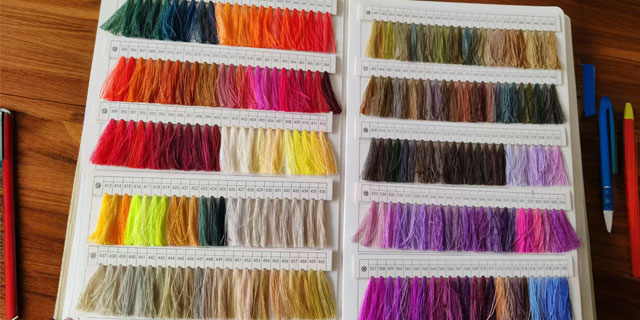
Available colors for Polyester Sewing Threads
שאלות נפוצות
1) What is polyester sewing thread best used for?
It’s widely used for apparel and industrial sewing because it typically offers a strong balance of durability, runnability, and wash resistance. The best match depends on fabric type, stitch type, and machine speed—polyester is a family of options, not one universal thread.
2) Polyester filament vs spun thread—what’s the real difference in production?
Filament thread is often smoother and can help reduce fuzz/lint in certain setups, while spun thread may offer a more “textile-friendly” handling and seam appearance for many apparel applications. The correct choice depends on your line’s friction/heat behavior and seam requirements.
3) How do I choose between 50/2, 50/3, 60/2, and 60/3?
Start with your fabric weight and seam durability needs, then confirm with a short A/B sewing trial. Track measurable outcomes like breaks per length sewn, tension adjustments, lint cleanup frequency, and seam appearance grading.
4) Why does thread break even when the datasheet shows high strength?
Breakage often comes from heat + friction + tension instability, not only “low strength.” Needle choice, thread path burrs, finish consistency, and tension tuning can matter as much as nominal strength.
5) How can I reduce lint buildup in high-speed sewing?
Check needle selection and thread path abrasion points first, then consider trialing a smoother filament option and tightening process control (threading method, tension stability, cleaning schedule). Measure the improvement per shift so the decision is data-based.
“Best Polyester Sewing Thread” Is the One That Runs Predictably
Let’s circle back to that buyer email: “We just need it to run.”
That’s the right goal—because the best polyester sewing thread is the one that delivers predictable production, not the one with the loudest claim. When you choose thread by type + size + finish + line reality, you stop firefighting and start standardizing.
If you want a clean next step, align your selection using the internal product references (filament No.5, 60/2 vs 60/3, 50/2 vs 50/3), then send your fabric + stitch + needle + speed + pain-point data through the site so recommendations become specific, testable, and repeatable.
Your machines don’t need poetry. They need consistency.
מאת Yarn
מוצר מומלץ
-
 חוט פוליאסטר DTY 100D/144F
חוט פוליאסטר DTY 100D/144F: המדריך המלא...
-
 חוט פוליאסטר DTY 100D/96F
חוט פוליאסטר DTY 100D/96F: הרך, היציב...
-
 חוט פוליאסטר DTY 75D/144F SIM
חוט פוליאסטר DTY 75D/144F SIM: הבחירה הטובה ביותר עבור...