 Vietnamese
  English
  Spanish
  Arabic
  Portuguese
  Russian
  French
  German
  Korean
  Japanese
  Italian
  Turkish
  Thai
Thai  Indonesian
  Dutch
Dutch  Hebrew
 Discover how to choose the best DTY Yarn for knitting and weaving. Learn about material selection, production process, performance testing, and expert insights to ensure durability, softness, and colorfastness in modern textiles.
Expert Dialogue
Product Manager: “We’re launching a performance knit and a lightweight woven. How do we choose DTY so both feel premium and last longer?”
Textile Expert: “Start with the function. For the knit, you’ll want a finer denier, higher filament count, and moderate interlace to get softness and stretch recovery. For the woven, pick a slightly higher denier with brighter luster and tighter interlace for stability and clean drape.”
Product Manager: “What about durability and color—will the garments hold shape and look new after washing?”
Textile Expert: “Yes—properly specified DTY resists pilling, retains color, and recovers shape. Verify with Uster evenness and tensile tests, and run dye/abrasion labs before bulk.”
Product Manager: “Can we make one spec work for both lines?”
Textile Expert: “You can, but optimizing per end-use gives better handfeel, fewer returns, and longer wear life.”
Takeaway: Picking DTY is not guesswork. It’s a fit-for-purpose decision: application → spec → lab validation → scale.
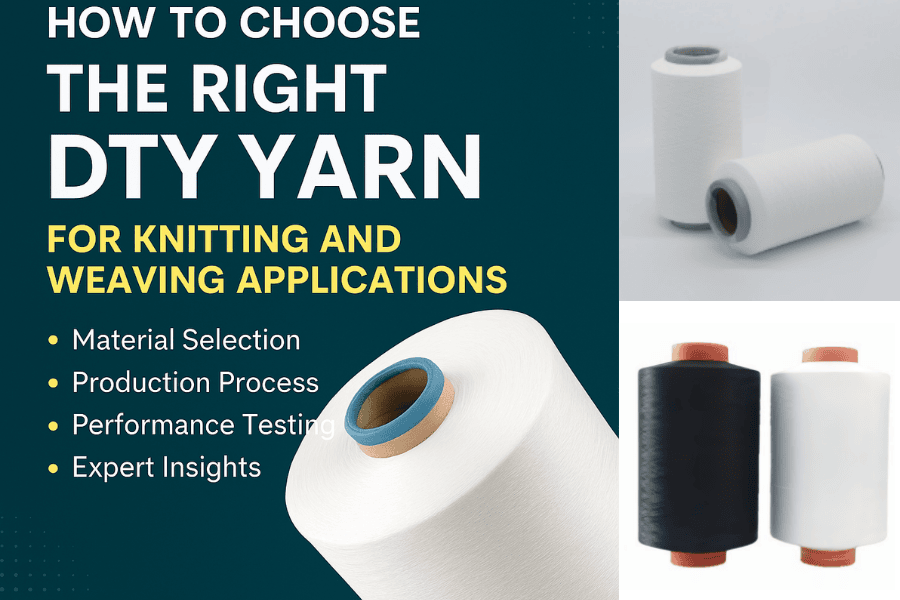
DTY vs “Other Polyesters” at a Glance
DTY’s crimped, elastic structure is what makes it excel in comfort and recovery for both knits and certain woven constructions.
Our DTY Yarn: Materials Selection (Why it’s better)
Staple: Virgin PET and rPET chip streams are selected to balance tensile strength with dye uptake; where sustainability is required, we specify GRS-eligible rPET with documented chain-of-custody.
Filament Architecture: Fine denier per filament (e.g., 75D/72F, 150D/144F) for soft hand; higher F-counts reduce “sparkle” and improve cover in knits. Trilobal or bright luster options add sheen for woven fashion.
Additives & Dope Color: Dope-dyed options (when specified) lock in color, reduce effluent load, and enhance lightfastness—useful for automotive/home textile applications.
Why this beats “ordinary” DTY: tighter control of viscosity, filament distribution, and spin finish yields better evenness, fewer broken ends on high-speed machines, and more consistent bulk after heat-set—translating into durability and lower claim rates.
Quality Proofs we use: Uster Tester (evenness U%, CVm, imperfections), tensile/elongation, dye fastness (wash, perspiration, light), abrasion/pilling. Uster is the global lab benchmark for yarn QC.
Our DTY Yarn: Process & Features (Why it performs)
Process Highlights
-
High-speed draw texturing aligns and crimps filaments for bulk/elasticity; 2) Interlace jets control entanglement for runnability; 3) Heat setting stabilizes crimp; 4) Precision winding improves package build for fewer stoppages in knitting/weaving. The outcome: soft, resilient yarns with stable crimp.
Performance Features
-
Elastic recovery & drape → comfort knits, stretch wovens.
-
Bulk & cover → fewer grin-through issues, cleaner fabric face.
-
Colorfastness & sheen control → semi-dull for natural look; bright/trilobal for fashion wovens.
-
Low care → wrinkle, shrink, mildew resistance; longer new-look lifecycle.
Compliance & Safety
We align with OEKO-TEX® STANDARD 100 for harmful-substance limits and support GRS for recycled programs.
How to Choose DTY Specs for Your Application
Knitting (circular/warp)
Soft tees/athleisure: 75D/72F or 100D/96F, semi-dull, moderate interlace (IM 40–60), low twist.
Compression/active: 75D/36F with elastane core or 150D/144F for plush with recovery; heat-set crimp for rebound.
Sweater gauge: 150D/144F or 300D/288F air-covered with spandex for loft and stretch.
Weaving
Lightweight fashion: 75D/72F bright/trilobal for clean drape and subtle sheen.
Home textiles: 150D/144F semi-dull for matte hand; higher interlace for stability.
Automotive/upholstery: 300D/288F dope-dyed; high heat-set for dimensional control.
Rule of thumb: higher filament counts (more F) → softer hand & better cover; brighter luster → more sheen; higher interlace → better weaving stability; heat-set → lasting crimp.
Verification: The Lab Numbers That Matter
Evenness (U%, CVm): lower is better—fewer barre/pattern streaks.
Imperfection Index: thin/thick places, neps; keep low to avoid defects.
Tensile/Elongation: ensure adequate strength and stretch for end-use.
Dye Fastness: wash, perspiration, light—especially for sportswear and interior fabrics.
Uster methodology and instruments (e.g., Uster Tester 6) are industry standards to quantify these metrics and benchmark lots.
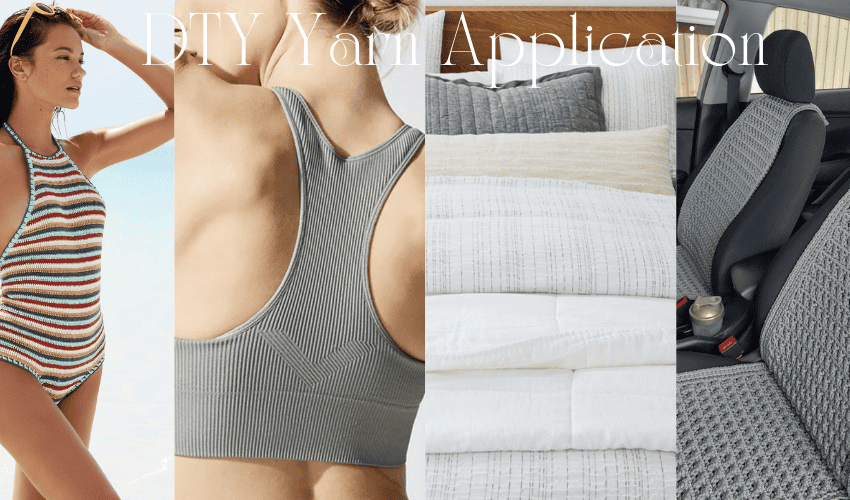
DTY Yarn Application
Expert Insights, Industry Trends & Scientific Data
What the science says: Texturing creates permanent crimp/loops in polyester filaments, improving elasticity, handfeel, and bulk compared with smooth filaments—key for comfort and recovery in apparel.
Market sustainability signal: Recycled polyester volumes are rising, but rPET’s share fluctuates (about ~12–13% of global polyester in 2023–2024), reflecting rapid virgin capacity growth and bottle-to-fiber dependence. If you target sustainability claims, lock certified rPET and be transparent.
Safety & compliance: OEKO-TEX® STANDARD 100 remains the mainstream label for harmful-substance testing from yarn to finished goods—useful for brand approvals and retail onboarding.
Expert view: “For high-speed knitting, pair fine denier/high filament DTY with robust interlace and confirm with Uster CVm and tensile data. You’ll reduce stops and improve first-quality yield.” — Senior Lab Manager, Tier-1 mill (summary of common industry practice based on Uster standards).
Real-World Plays
-
Athleisure knit (brand launch): switched from 100D/48F to 75D/72F semi-dull DTY with moderate interlace; pilling complaints dropped and wearer comfort scores improved after 25 washes.
-
Lightweight woven drape: adopted 75D/72F trilobal DTY in warp/weft for a soft luster, passing lightfastness and wash fastness for retail.
-
Production stability: after tightening interlace specs and heat-set windows, a mill cut loom stops by ~12% on a home-textile program.
User feedback: “Fabric keeps its shape and color after months of wear.” — large-format retailer review (internal QA summary).
Buyer Checklist
-
Target end-use → map to denier/filament/luster.
-
Set interlace & heat-set windows for process stability.
-
Validate with Uster & tensile; run wash/pilling/abrasion tests.
-
Select virgin vs. recycled (GRS) per brand goals.
-
Confirm OEKO-TEX® scope as needed.
-
Pilot on production machines before bulk.
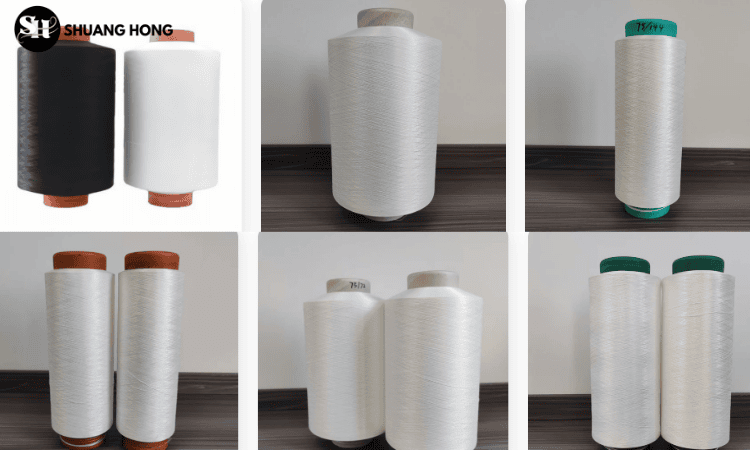
Polyester DTY Suppliers
FAQ
1) What is Sợi DTY used for?
Knits (tees, athleisure, hosiery) and select wovens (fashion, home, interiors) where soft hand and recovery matter.
2) How is DTY different from FDY?
DTY is drawn + textured (crimped, elastic); FDY is fully drawn and smooth, used where gloss and stability are prioritized.
3) Which DTY specs suit circular knitting?
Finer deniers with higher filament counts (e.g., 75D/72F) for soft hand; set moderate interlace for runnability.
4) How do I verify DTY quality?
Check Uster evenness (U%, CVm), imperfections, tensile/elongation, and dye fastness.
5) Is recycled DTY viable for performance wear?
Yes—rPET-based DTY can meet strength/fastness targets if filament design and finishing are tuned; secure certified supply.
References
-
USTER. “USTER® Tester 6 – the global benchmark for yarn testing.” https://www.uster.com/products/staple-yarn-testing/
-
USTER. “Quality parameters measured by UT fiber and yarn testing equipment (PDF).”
-
OEKO-TEX®. “STANDARD 100 Explained.”
-
OEKO-TEX® Secretariat. “STANDARD 100 (Full Standard, 2025) (PDF).”
-
Textile Exchange. “Materials Market Report 2024.”
-
Textile Exchange. “Materials Market Report 2025.”
-
Hengli Group (Global). “DTY Yarn Meaning: Understanding the Basics.”
-
Thai Polyester. “How difference between FDY and DTY Yarn.”
-
Leinuo Technology. “Draw Textured Yarn (DTY) – Ultimate Processing Guide.”
-
TextileLearner. “Uster Evenness Tester: Principle and Uses.”
-
GlobalPolyester. “Understanding the Differences Between DTY, FDY, and POY.”
-
TextileExchange / Enking, J. (via ScienceDirect). “Recycling processes of polyester-containing textile waste.”
“DTY Yarn is no longer just a polyester derivative—it’s a performance fiber engineered for durability, softness, and dimensional recovery. When chosen correctly, it outperforms natural yarns in lifecycle and sustainability metrics.”At Textile Supply Chain, we help buyers and manufacturers identify the ideal DTY Yarn specifications and maintain quality assurance from lab to loom—ensuring every fabric tells a story of strength and innovation.

Bởi Yarn
Sản phẩm nổi bật
-
 Sợi polyester DTY 100D/144F
Sợi polyester DTY 100D/144F: Hướng dẫn tối ưu...
-
 Sợi polyester DTY 100D/96F
Sợi polyester DTY 100D/96F: Mềm mại, ổn định...
-
 Sợi polyester DTY 75D/144F SIM
Sợi polyester DTY 75D/144F SIM: Lựa chọn hàng đầu cho...