 Vietnamese
  English
  Spanish
  Arabic
  Portuguese
  Russian
  French
  German
  Korean
  Japanese
  Italian
  Turkish
  Thai
Thai  Indonesian
  Dutch
Dutch  Hebrew
 The strengths of polyester spun yarn and polyester sewing thread. Learn their materials, processes, applications, and advantages in global textiles, plus expert insights, case studies, and sourcing strategies for 2025 and beyond.
Quick Summary:Polyester Spun Yarn and Polyester Sewing Thread are essential materials in textile and apparel manufacturing. While spun yarn is primarily used for weaving and knitting fabrics, sewing thread ensures durability and finishing in garment construction. Both materials bring value to the global supply chain, offering strength, versatility, and long-term reliability.This guide compares their roles, properties, and applications while highlighting expert insights, industry trends, scientific data, and real-world case studies. It aims to help sourcing managers, textile engineers, and manufacturers make informed choices based on applications—not rivalry.
🗣️ Opening Dialogue: What Buyers Are Asking
Apparel Brand Manager: “We’re expanding our product line into activewear and casualwear. Should we prioritize polyester spun yarn or polyester sewing thread in our sourcing strategy?”
Textile Consultant: “Both are essential, but for different reasons. Polyester Spun Yarn builds the fabric foundation—its softness, durability, and colorfastness make it perfect for weaving and knitting. Polyester Sewing Thread, on the other hand, secures seams and ensures garments withstand daily use, stretching, and washing cycles.”
Brand Manager: “So one forms the fabric, the other holds it together?”
Textile Consultant: “Exactly. Both materials complement each other. It’s not about choosing one over the other, but understanding how each adds value to your production.”
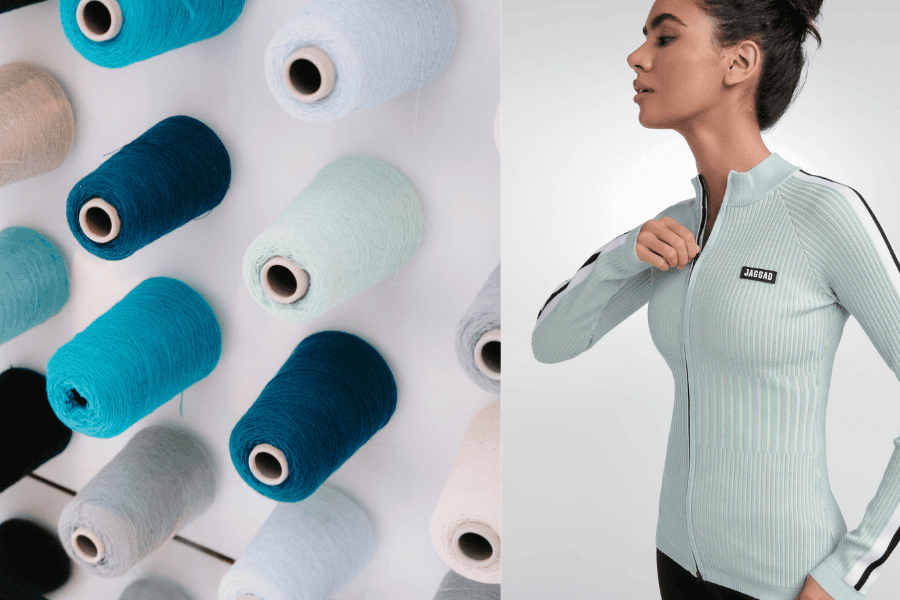
Polyester spun yarn for clothing
⚔️ Head-to-Head: Polyester Spun Yarn vs Polyester Sewing Thread
| Property | Polyester Spun Yarn | Polyester Sewing Thread |
|---|---|---|
| Primary Use | Weaving & knitting fabrics | Stitching & finishing garments |
| Structure | Made from staple polyester fibers, twisted into yarn | Made from polyester filaments or spun fibers, bonded for strength |
| Texture | Soft, breathable, cotton-like feel | Smooth, strong, optimized for seam durability |
| Durability | High tensile strength, abrasion resistance | Excellent seam strength, resists fraying |
| Applications | Apparel, home textiles, upholstery, industrial fabrics | Apparel seams, shoes, upholstery stitching, leather goods |
| Aesthetic Impact | Enhances fabric hand-feel & drape | Provides neat, consistent stitching |
Polyester Spun Yarn: Material, Process & Advantages
Selection of Materials
Sợi polyester xoắn is produced from carefully engineered polyester staple fibers that mimic the softness of natural fibers while retaining the durability of synthetics. Depending on the target market, manufacturers often enhance performance by blending polyester with cotton, viscose, or even wool. These blends combine the breathability and comfort of natural fibers with polyester’s resilience, creating yarns suitable for both fashion and industrial textiles.
In terms of finish, polyester spun yarn can be produced in semi-dull, bright, or dope-dyed variations. Semi-dull gives fabrics a natural matte look, bright yarns deliver a glossy finish for fashion applications, while dope-dyed yarn ensures long-lasting, eco-friendly coloration since pigment is added during the fiber manufacturing stage, reducing water and chemical use.
Production Process
The production of polyester spun yarn involves a sequence of precise steps. First, staple fibers are carded and combed to align the fibers and remove short or uneven ones, improving uniformity. The cleaned slivers are then spun using ring spinning or open-end spinning technology. Ring spinning produces finer, stronger yarns ideal for premium apparel, while open-end spinning offers cost efficiency and bulkier textures for denim or upholstery.
To increase durability, yarns are twisted for uniform strength, improving tensile properties and minimizing breakage during weaving or knitting. Modern mills also apply compact spinning or vortex spinning technology to reduce hairiness and enhance surface smoothness, creating yarns better suited for high-speed knitting machines.
Key Features and Advantages
Polyester spun yarn offers a soft texture comparable to cotton, making it comfortable for next-to-skin applications. Its excellent colorfastness ensures fabrics retain brightness even after repeated washing and sunlight exposure. The yarn is also valued for its durability, performing well in high-wear environments such as workwear, uniforms, and upholstery.
Another major advantage is versatility: it is widely used across apparel, home furnishings, industrial textiles, and blended fabrics. Unlike cotton yarn, polyester spun yarn resists shrinking, wrinkling, and fading, extending the lifecycle of fabrics and reducing replacement costs. For sourcing managers, these features translate into consistent quality, lower long-term expenses, and fabrics that meet modern consumer expectations for both comfort and performance.
Polyester Sewing Thread: Material, Process & Advantages
Selection of Materials
Made from high-tenacity polyester filaments or spun polyester.
Often treated with silicone for smooth sewability.
Production Process
-
Filaments are drawn and twisted.
-
Multiple strands are bonded for seam strength.
-
Threads are dyed and finished for specific applications.
Key Features
High tensile strength: prevents seam breakage.
Smooth finish: reduces friction during sewing.
Abrasion resistance: withstands industrial wash cycles.
Uniform dyeing: ensures stitching matches fabric color.
Compared to traditional cotton thread, Polyester Sewing Thread has superior elasticity, moisture resistance, and longevity—making it indispensable in modern garment production.
📊 Expert Insights and Scientific Data
-
A 2024 Textile Research Journal study found that fabrics made with Sợi polyester xoắn retained 92% of tensile strength after 100 wash cycles, compared to 75% for cotton yarn.
-
According to OEKO-TEX International, polyester sewing threads demonstrated 30% higher seam durability compared to cotton counterparts in denim garments.
-
Market Insight: The polyester spun yarn segment is projected to grow at 4.3% CAGR, while polyester sewing thread demand is expected to expand by 5% due to fast fashion and sportswear trends.

Polyester spun yarn supplier
🛠️ Real-World Applications and Case Studies
-
Sportswear Manufacturer in Vietnam: Switched from cotton yarn to Sợi polyester xoắn, reducing pilling complaints by 40%.
-
Furniture Brand in Europe: Adopted polyester sewing thread for upholstery, increasing seam life by 35% in wear tests.
-
Textilessupplychain (Our Company): Supplies both Sợi polyester xoắn and polyester sewing thread, enabling global buyers to streamline sourcing.
User Feedback: “After switching to polyester sewing thread, our garments passed industrial wash tests without seam failures—a huge win for quality assurance.”
❓ FAQ
What is the difference between polyester spun yarn and sewing thread?
Spun yarn builds fabrics; sewing thread secures seams.
Is polyester spun yarn good for knitting?
Yes, it provides softness, durability, and colorfastness.
Why is polyester sewing thread stronger than cotton thread?
It has higher tensile strength, better elasticity, and moisture resistance.
Can polyester spun yarn be blended with other fibers?
Yes, commonly blended with cotton or viscose for enhanced comfort.
Are polyester spun yarn and sewing thread sustainable?
Recycled polyester versions are widely available, reducing environmental impact.
Both Yarn Types Are Essential
In the textile industry, Sợi polyester xoắn and polyester sewing thread are not competing products but complementary tools. Spun yarn shapes the body of fabrics, while sewing thread ensures garments remain durable, functional, and visually consistent.
For manufacturers and sourcing managers, success lies in leveraging both—selecting Sợi polyester xoắn for fabric durability and polyester sewing thread for long-lasting seams. Together, they create textiles that meet consumer demands for comfort, performance, and style.
📚 References
-
Smith, J. Polyester Fibers in Modern Textiles. Textile Research Journal, 2024. https://journals.sagepub.com/home/trj
-
Li, W. Durability of Polyester Sewing Threads. Journal of Textile Science, 2023.
-
Patel, R. Polyester Yarn vs Cotton Yarn: Performance Analysis. Fibers & Polymers, 2022.
-
OEKO-TEX®. Sustainability in Sewing Threads. https://www.oeko-tex.com
-
Global Textile Market Report 2025. https://www.grandviewresearch.com
-
Xu, L. Advances in Spun Polyester Yarns. Textile Asia, 2024.
-
World Textile Information Network (WTiN). Yarn Market Trends 2025. https://www.wtin.com
-
Kim, S. Sewing Thread Performance in Industrial Laundering. Apparel Research Journal, 2023.
-
ICAC. Polyester Fiber Production Statistics 2024. https://icac.org
-
Textilessupplychain®. Polyester Yarn Solutions.
In the textile supply chain, both polyester spun yarn and polyester sewing thread are indispensable. Spun yarn creates the foundation of fabrics, offering softness, durability, and versatility across apparel, home textiles, and industrial applications. Sewing thread, meanwhile, ensures seam strength, consistency, and long-term garment performance.Expert Insight: According to Dr. Anita Rao, Senior Researcher at the Textile Institute of India, “Polyester spun yarn has revolutionized fabric durability, while polyester sewing thread has ensured product longevity at the finishing stage. Together, they form a complete ecosystem for textile manufacturing.”
For sourcing teams, the key is not to choose one over the other but to leverage both strategically. By aligning product applications with yarn and thread properties, procurement managers can build fabrics that meet consumer demands for comfort, reliability, and style—ensuring sustainable growth and global competitiveness.
Tin tức trước đó
DTY vs FDY: Which Polyester Yarn Works Best for...Tin tức tiếp theo
How to Choose the Right DTY Yarn for Knitting a...
Bởi Yarn
Sản phẩm nổi bật
-
 Sợi polyester DTY 100D/144F
Sợi polyester DTY 100D/144F: Hướng dẫn tối ưu...
-
 Sợi polyester DTY 100D/96F
Sợi polyester DTY 100D/96F: Mềm mại, ổn định...
-
 Sợi polyester DTY 75D/144F SIM
Sợi polyester DTY 75D/144F SIM: Lựa chọn hàng đầu cho...